
Snow days…I used to sneer at Oregon snow days: “In New Hampshire, we eat snow like this for breakfast.” Or “I’ve driven in much worse weather than this—a foot of snow doesn’t stop me.” Or “Even The Ark can cruise through an inch of snow.” But now, I love it. I’ve been out on the roads often enough with Oregon drivers to see the wisdom of closing down the world for two inches of snow and slush; I’m even MORE worried on cold clear mornings, when they think Black Ice is a damp roadbed. I’m staying home today. I’ll drink tea from my new Dogwood patterned tea cup, wash some clothes, and set the sleeve on my new sweater. Maybe make some yougurt and take a walk. Talk to the cats, who will be restless when the fascination of falling snow wears off. NOT grade papers or plan, but be thankful that I am not exposed to the very nasty flu that is traveling the halls of CHS. A snow day is a gift from the weather gods, to be embraced and treasured. Snow Day….
Corvallis has a tradition of Citizen Involvement, which means, when you are feeling positive, that city officials listen to the folks who live and pay taxes here before making decisions—and when you are cynical, that they allow the peasants to testify before going ahead with the plans they have already confirmed. Either way you look at it—and my opinion shifts, day to day—I’ve been testifying quite a bit lately. No matter where you are, the ritual is always the same—officials sitting behind a long table in front of the crowd, speakers facing the official people, with the entire group staring at their backs while they talk, a nervous line clutching notes on one side. You step up to the microphone, sign in, and speak. Time limit—three minutes. If you are good, the officials ask questions. If you ramble, they look through the piles of papers in front of them. Waiting in line is nervewracking. Testifying, once I have stated my name and address as incantation, is fun. I like to drop a phrase or two into the discussion and see if it takes off. “Party bay” for garage, “Mega-parties” that are “too big to fail,” “late adolescents” rather than students…I really like to answer questions, or, if allowed, to ask them. Afterwards, as you climb over others on your way back to your seat, people smile at you. “Nice job,” they whisper in the pause while the next speaker signs in. Then we all turn to listen to the next in line.
Wednesday, March 21, 2012


Sunday, March 11, 2012
March Gardens
The weather always comes from the West in Corvallis, so, if you look out of our living room window, you can see what will be happening in the back yard in about forty-five minutes. It can be very handy. This morning, after This American Life, I saw deep dark clouds on the way, so we headed out ahead of the storm. Yesterday, we had moved the chicken coop onto one of the new beds in the back of the yard and we needed to construct their summer run so that they could dig in the compost without destroying all of the delicate plant starts around the house. One swoop of a chicken’s foot has been known to take out a clump of crocus.
We quickly unwound the new spool of chicken wire fencing I had purchased from the farm supply store; I am done with kludging together rusty misshapen wire fences and being caught by it in awkward positions all summer long. The new wire snaked its way through the new garden, under a trellis and between two beds. Mark went inside—he had a meeting to go to—and I stayed out, wresting with the laurel hedge and garbage cans, bringing the new fence over to the edge of the yard; the chickens love our neighbor’s driveway and I wanted to keep them on our side of the property line even though our neighbors are very tolerant folk—they have been known to catch and repen our rabbits…. I pounded in the big fencing stakes, created a gate, and let the ladies out. They hopped out, commenting positively on the new run all the while.
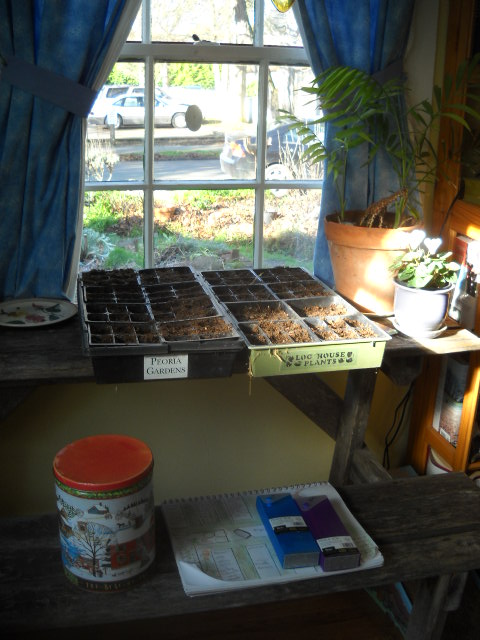
Another glance to the West—the clouds were closer, but not here yet. I moved quickly. The broccoli, mustard, kale, cabbage, and cauliflower seedlings were outgrowing their six-packs and needed a new home. Fertilizer, plants, trowel. Hoop house opened. Plants popped in. Plastic pulled back over. Clamps in place. One bed full. Clouds are overhead, but there was still time to take the windows off of the coldframe and plant the mustard and kale inside. Just as the windows went back on, the rains came. I tucked the tools back in the shed, considered the scene for a moment, and hurried inside.
Inside, the house still smelled of breakfast waffles and tea, lentils cooking in the crockpot. Kayli was curled up on the couch next to my knitting. The clock ticked loudly on the mantle and the hail hit the windows. March in Oregon.
We quickly unwound the new spool of chicken wire fencing I had purchased from the farm supply store; I am done with kludging together rusty misshapen wire fences and being caught by it in awkward positions all summer long. The new wire snaked its way through the new garden, under a trellis and between two beds. Mark went inside—he had a meeting to go to—and I stayed out, wresting with the laurel hedge and garbage cans, bringing the new fence over to the edge of the yard; the chickens love our neighbor’s driveway and I wanted to keep them on our side of the property line even though our neighbors are very tolerant folk—they have been known to catch and repen our rabbits…. I pounded in the big fencing stakes, created a gate, and let the ladies out. They hopped out, commenting positively on the new run all the while.
Another glance to the West—the clouds were closer, but not here yet. I moved quickly. The broccoli, mustard, kale, cabbage, and cauliflower seedlings were outgrowing their six-packs and needed a new home. Fertilizer, plants, trowel. Hoop house opened. Plants popped in. Plastic pulled back over. Clamps in place. One bed full. Clouds are overhead, but there was still time to take the windows off of the coldframe and plant the mustard and kale inside. Just as the windows went back on, the rains came. I tucked the tools back in the shed, considered the scene for a moment, and hurried inside.
Inside, the house still smelled of breakfast waffles and tea, lentils cooking in the crockpot. Kayli was curled up on the couch next to my knitting. The clock ticked loudly on the mantle and the hail hit the windows. March in Oregon.
Sunday, February 26, 2012
Week in Haiku
A Week in Haiku
Sunday:
Next meeting, we need:
Agenda. clock. raise hands?
My ears are tired.
Monday:
Tomatoes are up.
Brush with hands for strong stems.
Scent of summer food.
Tuesday:
CEA meeting.
Greet mayor; long council discussion.
Ready to sleep now.
Wednesday:
Feta cheese pie big hit.
Quaker potluck dinner laughs.
“Vegan in my heart?”
Thursday:
We knit, darn, mutter.
Warm fire, hear spider bite tales.
Quiet winter nights.
Friday:
Queen’s Chopstick dinner!
Spicy pad Thai, crisp broccoli,
Long, damp walk home—sleep.
Saturday:
I love the book sale.
Ride home in sleet, snow, big wind.
Happy to be here.
Sunday:
Next meeting, we need:
Agenda. clock. raise hands?
My ears are tired.
Monday:
Tomatoes are up.
Brush with hands for strong stems.
Scent of summer food.
Tuesday:
CEA meeting.
Greet mayor; long council discussion.
Ready to sleep now.
Wednesday:
Feta cheese pie big hit.
Quaker potluck dinner laughs.
“Vegan in my heart?”
Thursday:
We knit, darn, mutter.
Warm fire, hear spider bite tales.
Quiet winter nights.
Friday:
Queen’s Chopstick dinner!
Spicy pad Thai, crisp broccoli,
Long, damp walk home—sleep.
Saturday:
I love the book sale.
Ride home in sleet, snow, big wind.
Happy to be here.
Monday, February 13, 2012
The Frontier vs. Sacred Space
Americans love to move on…We come from moving on stock; our ancestors packed up and left family, friends, lands, and cultures behind, looking for a new start—economic, religious, or intellectual freedoms—risked everything to leave the old world behind and start over. It is in our genes. We have always been a restless people, searching for greener pastures or a better job or relationship, wanting to be anywhere else but here. It’s not a bad trait. However, we also tend to move on when we have messed up, physically or emotionally, leaving the thrashed area behind, finding wide open clean spaces ahead. Look at all of the boom towns, logged over areas, mining pits, and empty big box stores that litter our country. Bigger, better, and further on. It can be a problem.
It is a problem. The frontier is closed. Yeah, it closed, metaphorically, in the mid- nineteenth century, but then there was Alaska, or Space, or that vast empty area in the upper mid-west, and we did not quite realize our limits. We’ve found them. There are no clean places left. We are almost out of oil, which allows us to move so quickly. Our atmosphere is at a tipping point right now and may not be salvageable. We need to reach within ourselves and find the other side to moving on, an idea that also lurks deep within our psyche as Americans—the desire to stay in one space, to know our place, to defend our homes with our full spirits and lives.
This desire is deep within us. Look back at Thoreau and his writings on Walden Pond—part scientific analysis of plants and water tables, part rant on American ideals, and part spiritual exploration of the nature of place. Others have followed—the Local Color movement of the late nineteenth century and the nature writers of the twentieth. Read Mary Wilkins Freeman and Sarah Orne Jewett, Willa Cather and Robert Frost and learn how the land shapes our choices, our world, if we let it. Study Aldo Leopold, Rachel Carson, Henry Beston, Edward Abbey, Terry Tempest Williams, Gary Snyder, and Barbara Kingsolver. They all love their homeplaces. Drive across the country listening to the music that has come from different regions and you understand the land and people. Understanding leads to love—and love to a desire to protect what we value.
Corvallis has become my home—more specifically, my house has become my sacred land. A house, to me, is not an investment to be occupied for a few years before moving on. I did that when I was young. My family was peripatetic. We moved every year or so, starting when I was eight and my parents sold the house they had built together and hit the road. My grandparents moved regularly as well, always searching for the better deal. By the time I was 13, I could pack a kitchen in two hours flat, unpack it in the same amount of time and not break a dish. I know how to move. All of my belongings will fit in my van (not all at once).
When I moved into my house, I did not expect to stay so long. But, about a year in, I was staring out the bathroom window (it has a lovely view of the backyard), when I felt the spirit of the house settle around me. It had been a rental all of its life, I believe, owned by an OSU professor who specialized in camellias and lived next door. People loved living here; in 1941, a grandparently couple planted the fig, yellow plum, and cherry trees in the yard. It has never been abused as a building. However, it has never been owned. That sunny day, I felt the old occupants, the planters of trees and flowers, as well as the building itself, enter my soul. This is my home. My house, my land. One tenth of an acre and a 625 square foot house—it’s not much, but it is mine. I share it with Mark, it is true, but it is part of me, not so much him. It is worth defending.
People move regularly in Corvallis. When students move into the neighborhood, bringing noise and cars, looming bad developments and booming beats in the middle of the night, rather than fight, they leave, shifting to the edge of town or out into the country. I understand the impulse; I’ve considered moving my house out of town a time or two myself. (The difference may be—I’d take the building with me.) But then, I grow stubborn. Why should I give in? Besides, where would I find what I have here—a small, solid old house, a large lot, within walking distance of everything—that I could afford. We own this house outright. That is a huge deal in uncertain economic times. So I fight back. I fuss. I write letters. I organize. I research. I even nag. This is sacred ground—and there is no frontier any longer. This is the final stand.
It is a problem. The frontier is closed. Yeah, it closed, metaphorically, in the mid- nineteenth century, but then there was Alaska, or Space, or that vast empty area in the upper mid-west, and we did not quite realize our limits. We’ve found them. There are no clean places left. We are almost out of oil, which allows us to move so quickly. Our atmosphere is at a tipping point right now and may not be salvageable. We need to reach within ourselves and find the other side to moving on, an idea that also lurks deep within our psyche as Americans—the desire to stay in one space, to know our place, to defend our homes with our full spirits and lives.
This desire is deep within us. Look back at Thoreau and his writings on Walden Pond—part scientific analysis of plants and water tables, part rant on American ideals, and part spiritual exploration of the nature of place. Others have followed—the Local Color movement of the late nineteenth century and the nature writers of the twentieth. Read Mary Wilkins Freeman and Sarah Orne Jewett, Willa Cather and Robert Frost and learn how the land shapes our choices, our world, if we let it. Study Aldo Leopold, Rachel Carson, Henry Beston, Edward Abbey, Terry Tempest Williams, Gary Snyder, and Barbara Kingsolver. They all love their homeplaces. Drive across the country listening to the music that has come from different regions and you understand the land and people. Understanding leads to love—and love to a desire to protect what we value.
Corvallis has become my home—more specifically, my house has become my sacred land. A house, to me, is not an investment to be occupied for a few years before moving on. I did that when I was young. My family was peripatetic. We moved every year or so, starting when I was eight and my parents sold the house they had built together and hit the road. My grandparents moved regularly as well, always searching for the better deal. By the time I was 13, I could pack a kitchen in two hours flat, unpack it in the same amount of time and not break a dish. I know how to move. All of my belongings will fit in my van (not all at once).
When I moved into my house, I did not expect to stay so long. But, about a year in, I was staring out the bathroom window (it has a lovely view of the backyard), when I felt the spirit of the house settle around me. It had been a rental all of its life, I believe, owned by an OSU professor who specialized in camellias and lived next door. People loved living here; in 1941, a grandparently couple planted the fig, yellow plum, and cherry trees in the yard. It has never been abused as a building. However, it has never been owned. That sunny day, I felt the old occupants, the planters of trees and flowers, as well as the building itself, enter my soul. This is my home. My house, my land. One tenth of an acre and a 625 square foot house—it’s not much, but it is mine. I share it with Mark, it is true, but it is part of me, not so much him. It is worth defending.
People move regularly in Corvallis. When students move into the neighborhood, bringing noise and cars, looming bad developments and booming beats in the middle of the night, rather than fight, they leave, shifting to the edge of town or out into the country. I understand the impulse; I’ve considered moving my house out of town a time or two myself. (The difference may be—I’d take the building with me.) But then, I grow stubborn. Why should I give in? Besides, where would I find what I have here—a small, solid old house, a large lot, within walking distance of everything—that I could afford. We own this house outright. That is a huge deal in uncertain economic times. So I fight back. I fuss. I write letters. I organize. I research. I even nag. This is sacred ground—and there is no frontier any longer. This is the final stand.
Sunday, February 5, 2012
Candlemas Weekend
 |
| Lucy and breakfast |
 |
| Moonrise |
 |
| new crops |
 |
| first bloom |
 |
| Left over from Winter Solstice rituals |


 |
| first egg-- and we still have long keeper tomatoes |


Sunday, January 29, 2012
New Beds
 I’ve expanded the garden this year by dragging in three more bed frames that once lived in the backyard of our rental house down the street. I thought I’d be able to care for two gardens, one half a block away, but it did not work. We could never really sort out the watering and plants that are not checked on every day just do not thrive. Even potatoes grew better here, rather than at The Annex. The move has changed the backyard dynamics fairly drastically. The chickens have a reduced summer run—but they never used the full sun area anyways—and, more significantly, the perennial beds that were once the edge of the garden are now the spine, with perpendicular beds, like ribs, on either side. I’ve been working on integrating the plan for about a month now.
The first step was a new crop rotation. About five years ago, I’d worked out a seasonal system for the five beds—Spring, Climbing beans, Summer, Fall, and Vines—which worked well. I could send Mark out to pick lettuce from Summer and he could be confident that he was harvesting the right plants (he accidentally harvested several cabbages as a child and the event left him with a fear of wasting food by accidental harvest). Beds filled and emptied out in a systematic way, so the chicken tractor could rest on an empty bed earlier in the season—by Fall Equinox, most years. Adding three potato beds and winter onions and garlic threw the system off. After hours on contemplation, I decided to keep the potato together, so, this year, the beds move from garlic/onions (later winter veg), three potatoes, beans, vines, around to the other side: summer (including cucumbers, which used to be a vine), roots, and spring. The only problem is, we need an eight-foot cold frame….
The other consideration was more visual. After years of empty space, the new beds looked odd sitting in the middle of the chicken run. So I spent yesterday building two new trellises out of hazelnut trimmings, nailing the uprights to the beds then lashing the rest together with twine. Scarlet runner beans and morning glories will cover them this summer. It is not as sturdy a system as nailing everything together, but this is merely a seasonal experiment. If it works, and the two light trellises, which now indicate where the gates to the chicken run will be, bring the space together, I will build sturdy ones next fall—I was thinking of making one, at least, flat with a cat perch platform…
I like the new look. There’s a lovely focus down the yard to the back gate. There is a new sitting area under the kiwi arch. There will be a lot more food growing in the backyard in July. And the chickens will still have the run of the bushes and compost piles, back pool and, unfortunately, some of the thornless blackberries. Changes are good.
Tuesday, January 17, 2012
Cabbage Days
It is Cabbage Season. Steve Solomon, in his great book Growing Vegetables West of The Cascades, mentioned these seasons, but I was skeptical. Cabbage years—that can’t happen. There's always something else to eat. Well, it is here. The long dank spell in December, followed by Solstice, has shut down green growth. Sunbow has been closed for three weeks. We went to the co-op today looking for local greens from the larger farms. Nothing. No chard, no spinach, no kale! There was a small bowl of salad greens, which Mark scooped up. No broccoli, no cauliflower, no….wait—there is cabbage. In the corner of the produce shelf, piles high—red and green cabbage. Locally grown. Still looking lively. Cabbage. “What,” Mark asked apprehensively, “Are you going to do with that?”
What am I going to do with it? I looked in the cookbooks. Alice Waters and Deborah Madison, the Grand Dames of local food, had no thoughts on the matter—except for sautéing it in duck fat. Cabbage is clearly a low-brow vegetable. Molly Katsen—not much. There’s a Creamy Cabbage Soup in Moosewood….and there’s lots of lovely variations of coleslaw in my book of winter vegetables. In comparison to say, corn or tomatoes, it's pretty slim pickings. Here’s the plan…
Monday: burritos with chipolte slaw
Tuesday: Cabbage sauteed with onions, a ton of dill and black pepper, and served over noodles
Wednesday: Onion and Olive pizza with steamed cabbage and a scrap of broccoli
Thursday: Squash Gnocchi and salad, stretched with shredded cabbage
Friday: Fried rice with old carrots, new cabbage, onions, and some frozen peas
Saturday: Salmon and peas—no cabbage
Sunday: White Dinner—cabbage and potatoes mashed together with butter and maybe a bit of paprika for color and seared tofu with red pepper and lots of garlic
I’m hoping for some red mustards, at least, next week!
Subscribe to:
Posts (Atom)